Photographs and narratives by ROBERT LEUTHEUSER from and of his travels through Kurdistan and the greater Middle East. Published in conjunction with his photographic website www.beyondbordersphotography.com.

All images and text are protected by copyright law. Please contact Robert Leutheuser at robleutheuser@gmail.com for any and all uses. Thank you.

16 April 2017

Yet Another Return to Sinjar, April 2017 - Part 2

Sinjar City
The destruction on the south side of Sinjar Mountain was utter. This was Daesh's first target in early morning blitzkrieg on August 3, 2014 which sent thousands of Yezidis up the steep slopes of the mountain to escape. Many made it; many did not. It was here that Daesh murdered, kidnapped, and defiled with unbridled abandon for a year and a half. They still control much of the area, but Sinjar City and a narrow band along the foot of the mountain was militarily retaken in December, 2015. I returned, accompanied by Gharbi and two soldiers from Hayder Shesho's Ezîdxan Forces. It was here I would see more destroyed Yezidi shrines.


The Kurdish and Yezidi armies failed to unite following their conquest in the north. It was the YPG, the Kurdish army from Syria and PKK affiliate, that was the first to respond to the attack, quickly opening a pathway of escape to Syria for the Yezidis stranded on the mountain. Soon the PKK, the Kurdish separatist army from Turkey, arrived. Finally there was the Kurdish Democratic Party's (PDK, the Kurdish acronym) peshmergha which engaged in the fight after initially abandoning the Yezidis to Daesh.  It is a dizzying soup of acronyms and identities. The flags were many, the reasons not: Staking claims and legitimacy. And meddling all the while were regional and international political forces.

Qasim Shesho and Hayder Shesho
Qasim Shesho ultimately allied his Yezidian army of 8,000 with the PDK's peshmergha, flying the Kurdistani flag. Many Yezidis would not accept the partnership with those they blamed for their plight, so Qasim Shesho's nephew Hayder Shesho formed an independent army of 2,000 Yezidis under their own flag. The relationship between the two is amicable. The YPG and PKK, having spilled blood in the liberation of the north, formed their Yezidian units and have not left.

[Update:  On 17 April 2017 Hayder Shesho formally allied his army with Qasim Shesho's and the PDK peshmergha.  At the same time he formed a new independent political party, splitting from the PUK, the other major party in Kurdistan.]


PKK Memorial to their martyrs
The situation reached a flash point in March 2017 when the YPG and peshmergha armies fought in the town of Khanisor. Yezidis killing Yezidis. Both sides retreated to rationality before the situation escalated.

As the parochial consequence to me, concerns about Daesh were secondary to the relationships between the flags. I was accompanied by Hayder Shesho's men because he had a better relationship with the PKK who controlled some of the areas we had to pass through. The irony of proximity was stark, hilltop bunkers of competing flags within tens of meters of one another, and checkpoints separated by less than a kilometer. There was no hostility between them; they were merely soldiers.


[Update:  On 25 April 2016 Turkey conducted airstrikes against YPG and PKK postions in the Sinjar.]

Yet Another Return to Sinjar, April 2017 - Part 3

Yezidi shrines are places where Yezidis pay unburdened homage to god (xode) and his angels, where they remember the departed, and where they gather. Yezidi'ism is inseparable from the community and cultural mores. As such, the shrines are the center of the communities, and where Yezidis joyfully gather on fesival days, of which there are many. Daesh, not content to kill and enslave, set out to destroy the fact and symbols of the Yezidi life.


tawaaf at shrine, 2012
We drove around the east end of the mountain where it blended into the Mesopotamian Plain, and then we turned west towards Sinjar City, the epicenter of destruction. We passed through the twisted wreckage, some of it disarmingly graceful, and crankled up the rocky road to the place of the Amadine Shemsa shrine. The burned out and rusting carcasses of cars and trucks marked the way. 

Said, a burly and kindly soldier with a weeping eye that chose its own way, told of his nearby village of Merkhan where 67 Yezidis were executed. Within minutes Gharbi was showing me a slickly produced Daesh video of two boyish suicide bombers killing themselves and others in Merkhan on his smart phone. I recoiled but did not look away.


Five minutes later, Said pointed across a rocky field to a small fenced-in area on a hillside next to a narrow wash, its peacefulness belied the horror.  We walked, I slower than they.  Here the remains of 67 bodies, temporarily covered by small hills of dirt, lay until they can be properly recovered and buried. The small yellow flowers of spring wanted to bloom.

We arrived at Amadine Shemsa.  The site was perched on the top of steep hill that thought itself a mountain.  In 2014, during my last visit, the Yezidis were rebuilding the shrine, the old spire half entombed in a bright new tower, its new flutes hewn from blocks of rock. knife sharp. Now there was but a pile of stone. It was only the top of the old spire peek tiredly tilting to the side that gave clue to at was here before.


Incongruently, a Yezidi grave surrounded by the sharp tumble still had faded plastic flowers attached to its poles.

We looked out over the plains to the south and east. “There, Tel Benet, still Daesh. And there, Ranbusi. Daesh.” The towns were 10 kilometers away. My stomach turned, not in fear, but in rage. I exhaled and continued to search for the story with the camera.

The journey to document the fury of a few and the tears of many continued. An hour later we arrived at Pir Mahmed Rashan which also was being rebuilt 3 years ago with a new broad stairway leading up to the shrine.


Only the stairs parially remained, topped by long twisting water snakes of reinforcing steel.

Gharbi pointed down to the valley behind Rashan. The valley was speckled with dark brown spots below. “You see? Cows. All cows.” Or so I thought he said, suggesting that more Yezidis had returned. But his accent is heavy. It was a herd of burned car and truck carcasses.

We returned to the outskirts of Sinjar City, to the site of a once a fairy tale collection of small Yezidian spires, known locally and unofficially as Piçuk (little) Lalish.


2012
No longer. Now it was a hellish spectacle of small spires strewn about, several looking like bad science fiction rocket ships that had crashed and were piercing the the ground.


The ruins of the Sheikh Hasan shrine were different: It heavily proclaimed its former self with the its spire remaining largely in tact, but settled askew atop the brutal rubble of the room below.


The afternoon became long as we continued west to Sheikh Mend Pasha, in Yezidi cosmology the patron of the tribe that can handle snakes without fear of harm. This is Gharbi's tribe.

To the south of us, the frontline between Daesh and the Kurdish/Yezidi force gradually merged with the road, until the high earthen berm frequently punctuated by heavily armed cells became the road's shoulder. We were approaching the end of liberated area. The road and berm swung to the north towards the parallel mountain.  A field of blood red poppies would not be suppressed. We were once again on a dirt track, slowly discovering our way to the shrine.

Shiekh Mend Pasha too had been rebuilt with scant attention to architectural fidelity before Daesh.  As before, in front of the erstwhile shrine stood the same tortured tree festooned with swaths of faded colored silk tied in unruly knots representing wishes of those who tied them years before. It now somehow better suited the scene. 


2012


2017
And propped against a wall of the ruins was a broken stone with the bas relief of a snake, freshly repainted black. It was not forgotten, but the site stood in absolute ruin. Slabs of the long flat roof had collapse to the center and pieces of the spire littered the area.

Sheikh Mend Pasha also was, and is, the site of a memorial commemorating the 2007 car bombing in the nearby Yezidi town of Girezer, still occupied by Daesh. On August 14 of that year, car bombs attributed to Sunni radicals killed 500 Yezidis and wounded 1,500 more. The Yezidis declared it their 73rd Genocide The memorial - a cemetery of many of those killed and a large building housing hundreds of pictures of the victims - remained. Gharbi surmised that Daesh did not have time to desecrate the site because of being attacked by Yezidi forces.


It is unnerving to find relief in the survival of memorial to another act of evil perpetrated on the very same people.

I was tired. We drove back to Sinjar City, and over the mountain to Zorava.


___________________________________________________

As always I want to acknowledge my friend Sheikh Gharbi who accompanied me on all of my visits to the Sinjar.  Without him I would not have been able to complete this journey of discovery, friendship and photography that has spanned 8 years.


21 May 2015

The Reunions Were Reaffirming, But Not So the Stories


In August 2014 the self-proclaimed Islamic State attacked the Yezidis in their heartland in northern Iraq.  The black flags showed no mercy.  Hundreds of thousands of Yezidis are now are refugees, among them good friends of mine.  I recently went back to see them; the reunions were reaffirming.


They shared their stories of terror-filled escapes and multiple resettlements, but they knew they were among the lucky who did not lose any immediate family member to death or captivity.  The intimacy of the descriptions of the experiences did not allow their stories to be minimized.

But all around the other stories, some of which I heard,  filled the air with an invisible weight. The tellers were compelled to tell, and all were compelled to listen.  Everyone has a story; everyone is a story. 

(The following names have been changed.)


Khider escaped from the jihadists 3 weeks before we met.  He and other Yezidis, initially numbering 800 in his group, were moved from town to town during his near-eight months of captivity.  Fear built their walls of imprisonment, and his recollections were a tangle of rusty barbed wire:  An old woman accused of being a witch beheaded; his sons being taken away to be converted to Islam and trained as jihadists; threats of being killed for little or no reason.  “I was not afraid of dying.  I was afraid of being tortured,” Khider said as he lit yet another cigarette.


Young teen-aged sisters Amsha and Rêsan entered the tent with uncertainty. They sat on their haunches and avoided eye contact.  Knowing that the girls were not going to talk, their uncle chimed in to tell their story for them.  The girls had been recently release after being held captive by the Islamic State jihadists since last August.  Someone had paid a ransom, but that was not discussed.  While in captivity Amsha pretended she was retarded, her lazy left eye helping the ruse.  Following suit, younger Rêsan chopped her hair short.  They were not sold and were returned unmolested for which all were grateful.  Nobody knows where their parents are, the uncle said. The girls' eyes remained locked on the ground.


Unlike most others, Ferhan was immediately engaging in recounting his story.  He and his family ran to the mountain when they heard of the Islamic State’s barbaric attacks on the other side of Mount Sinjar.  They and thousands of others took refuge at a spring tucked in the mountain, “drinking only drops of water.”  After 2 days they were reduced to eating the low quality grain intended for sheep, “… and finally all we had was leaves and grass to eat.”  After a week  an escape route was opened up through nearby Syria.  Ferhan’s family joined the Biblical throngs crossing the brittle landscape of summer.  Some died.


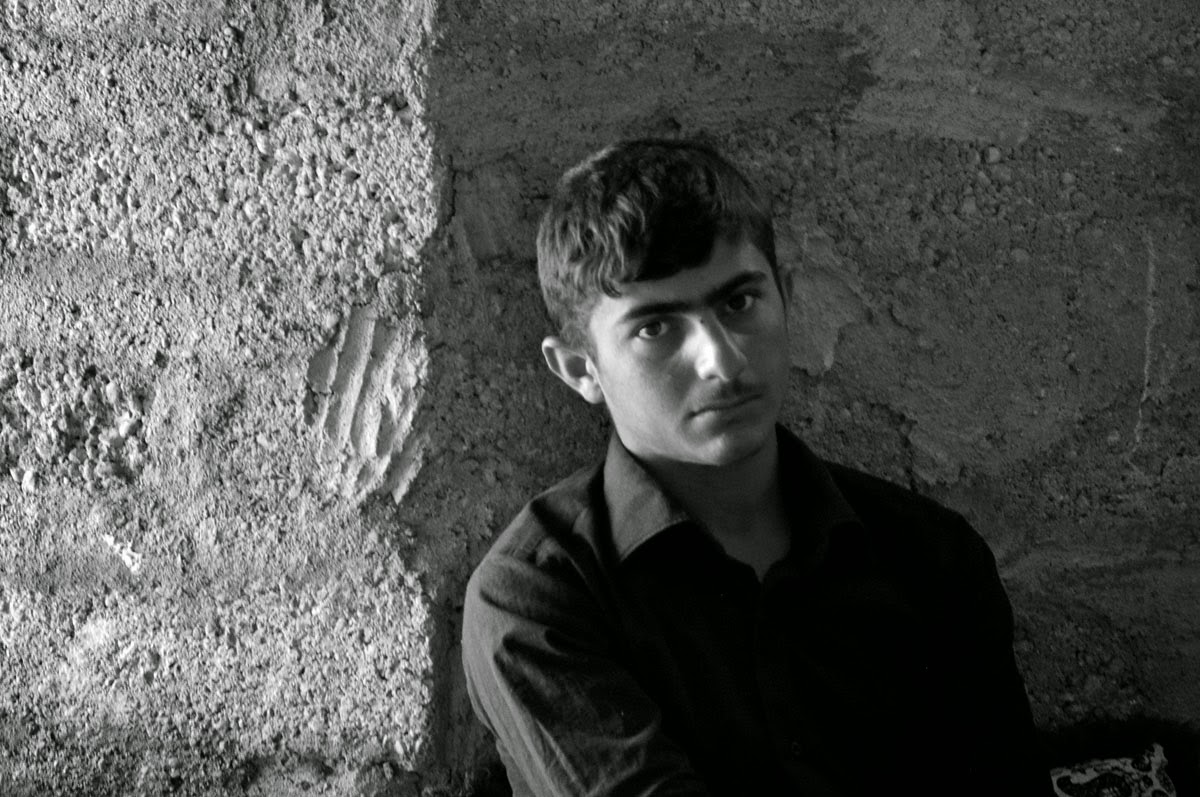
Faisel silently entered the room of the half-completed house, and immediately sat on a thread-worn mat by door.  He was thin with a young man’s soft mustache, and the familiar vacant look from hollow eyes.  He and his family tried to escape the jihadists on the first night of the attack, fleeing up Mount Sinjar’s southern steep zig-zagged road.  His parents and five of his siblings were captured, and there has been no news from them since.  


There was an edgeless matter-of-factness in the voices that only faintly suggested their sufferings, and their deeply shadowed futures.


I choose to believe that, as they have done throughout their long, uneven, and rich history, the Yezidis will survive; and, that they will again find prolonged moments of affirmation and joy in themselves, community, and religion.